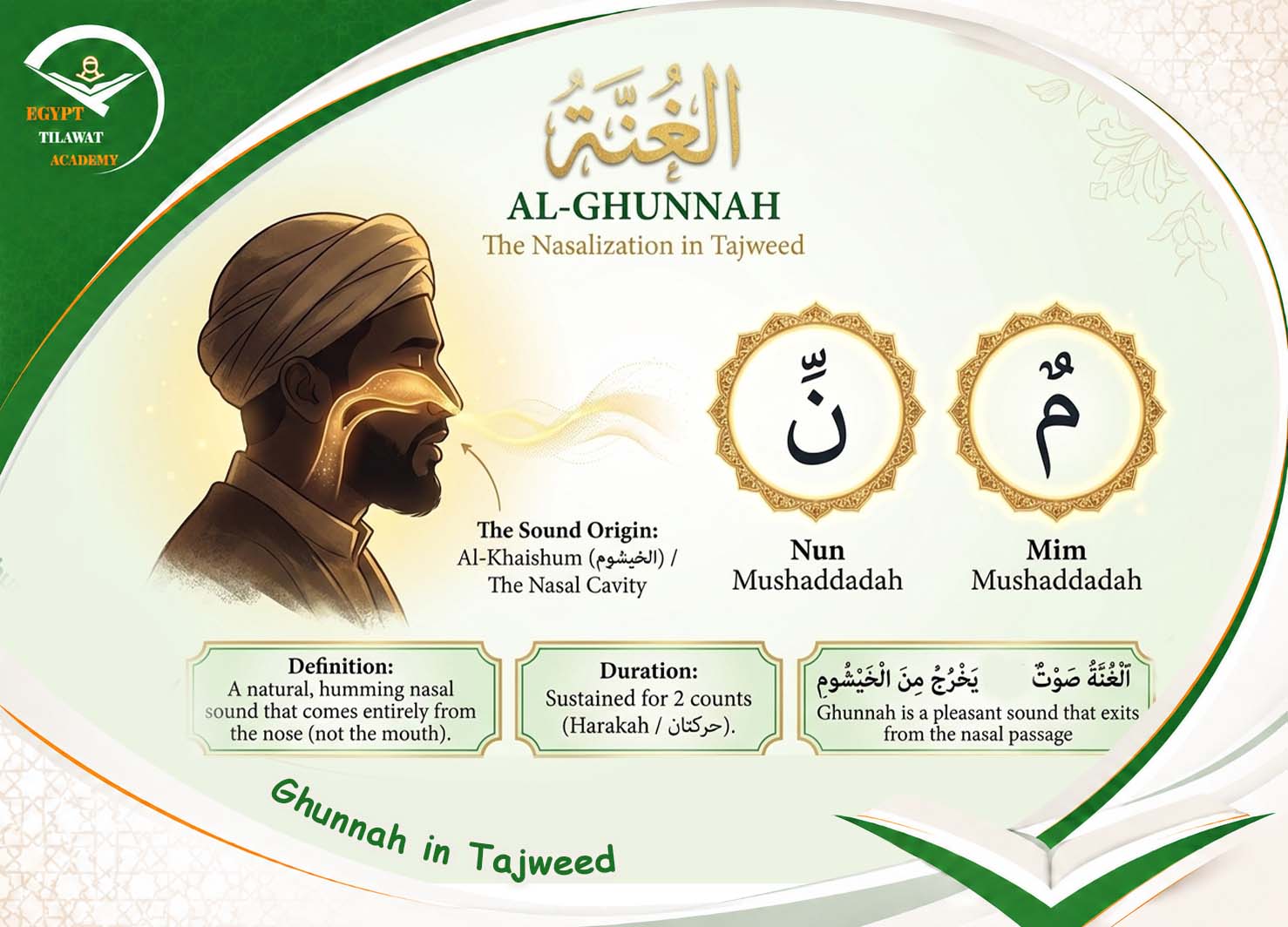
Ghunnah in Tajweed
Ghunnah in Tajweed refers to the
nasal sound produced when pronouncing the letters ق
(qaf), غ (ghayn), ع
(ain), and ح (ha) when they are accompanied by a sukun
or at the end of a word. It involves a prolonged, resonant vibration in the
nose, creating a distinctive auditory effect. Ghunnah is essential for accurate
Quranic recitation, ensuring proper pronunciation and adherence to Tajweed
rules. It enhances clarity and beauty in recitation while preserving the
integrity of Arabic phonetics.
Ghunnah in Tajweed (غُنَّة) is a soft, resonant nasal sound produced
in the nasal passage (the Khayshoom, الخَيْشُوم)
during Quran recitation.
It is an inseparable characteristic
built into the structure of two specific Arabic letters: Noon (ن) and Meem (م).
When you pronounce them under certain Tajweed rules, you hold a humming or
nasalized sound for two counts (harakatayn).
Many students recite with the right
letters and the right vowels, yet something still sounds slightly off. Very
often, the missing piece is ghunnah in Tajweed: the soft, resonant nasal
sound that gives the Quran its distinctive flow. Once you hear it and learn
when to apply it, your recitation becomes smoother, more accurate, and more
beautiful.
In this guide, we explain what
ghunnah is, when it appears, how long to hold it, which mistakes to avoid, and
how to practice it step by step. Every example comes from the Quran, and every
Arabic term is explained in plain English, so it works whether you are a
complete beginner, a revert, or a parent supporting your child.
What
Is Ghunnah in Tajweed?
Ghunnah in Tajweed (غنّة) is a nasal sound produced from the nasal passage, not the mouth or throat, that accompanies the letters noon (ن) and meem (م). In tajweed, it is normally held for about two counts (harakat).
Linguistically, ghunnah
refers to a nasal humming sound. Technically, in tajweed, it is a quality
attached to noon and meem, and it comes from the khayshoom (الخيشوم), the nasal cavity at the top of the
throat. This is different from the makhraj (articulation point) of most
letters, which is in the mouth or throat.
A simple way to feel it: say
"mmm" with your lips closed, then pinch your nose gently. The sound
should change or stop. That vibration through the nose is ghunnah.
How to say it: GHOON-nah, with a soft "gh" made at the
back of the throat, similar to the French "r."
Why
Ghunnah Matters in Quran Recitation
Tajweed means giving every letter its due right. Ghunnah in Tajweed is part of that right for noon and meem, so omitting it, shortening it, or exaggerating it changes the quality of the recitation, even if the words are correct.
There are three reasons it deserves
your attention:
- Accuracy:
Tajweed rules preserve the way the Quran was taught and passed down from
teacher to student through an unbroken chain of recitation.
- Beauty:
Correct ghunnah gives recitation its smooth, melodic rhythm.
- Confidence:
Once you know the handful of ghunnah cases, large portions of the Quran
become much easier to read well.
If you are a beginner or a revert,
take heart: ghunnah is very learnable at any age. It is a small set of rules,
repeated constantly, so practice pays off quickly.
How Long Should Ghunnah Be Held?
- In applied rules like Mushaddad, Idgham, Ikhfa, and Iqlab, the Ghunnah is typically held for two counts.
- When Noon or Meem appear with a normal vowel or simple Sukoon without an active assimilation/concealment rule, the inherent Ghunnah is still there naturally but is not artificially lengthened for two counts
A Quick Test
To check if you are producing
Ghunnah correctly, gently pinch your nose closed while pronouncing a doubled
Noon (نّ) or Meem (مّ).
If the sound is completely blocked or distorted, it proves the sound is
traveling through your nasal cavity.
When
Does Ghunnah in Tajweed Occur? The Main Ghunnah Rules in Tajweed
Ghunnah in Tajweed appears in five main situations. The examples below follow the Hafs 'an 'Asim recitation, the most widely read in the world, and use the standard Mushaf.
1.
Noon and Meem with Shaddah (Ghunnah Mushaddadah)
Whenever noon (نّ) or meem (مّ) carries a shaddah,
you must produce a full ghunnah. This is the strongest form.
- إِنَّ (inna)
- ثُمَّ (thumma)
- النَّاسِ (an-naas)
Hold the nasal sound for about two
counts before moving on.
2.
Idgham with Ghunnah (Letters ي ن م و)
Idgham means "merging." When a noon sakinah (نْ) or tanween is followed by one of
the four letters ي ن م و (remembered by the
word yanmu) in the next word, the noon merges into the following letter,
and you add ghunnah.
- مَن يَعْمَلْ (may-ya'mal), as in Surah
Az-Zalzalah 99:7
- مِن مَّاءٍ (mim-maa'in)
In this case, the noon sound
disappears into the next letter, but the nasal sound remains for about two
counts.
Important exception: If the noon sakinah and one of these letters appear in the same
word, the noon is pronounced clearly (idhar). Four such words in the Quran
are دُنْيَا, بُنْيَان, قِنْوَان and صِنْوَان. Your teacher will point these out.
3.
Ikhfa (Hidden Pronunciation)
Ikhfa means "hiding." Noon sakinah or tanween followed
by any of the 15 letters is pronounced in a light, hidden way, between a
clear noon and a full merge, with ghunnah. The 15 letters are: ت ث ج د ذ ز س ش ص ض ط ظ ف ق ك.
- أَنتُمْ (an-tum)
- مِن قَبْلُ (min qablu)
The tongue does not touch the roof
of the mouth as it would for a clear noon. Instead, it hovers near the position
of the next letter while the sound resonates through the nose.
4.
Iqlab (Noon Sakinah or Tanween Before Ba)
Iqlab means "conversion." When noon sakinah or tanween
is followed by ba (ب), the noon changes
into a hidden meem, and you pronounce it with ghunnah while keeping your
lips lightly closed.
- مِن بَعْدِ (mim-ba'di), as in Surah Al-Baqarah 2:27
- سَمِيعٌ بَصِيرٌ (samee'um-baseer)
5.
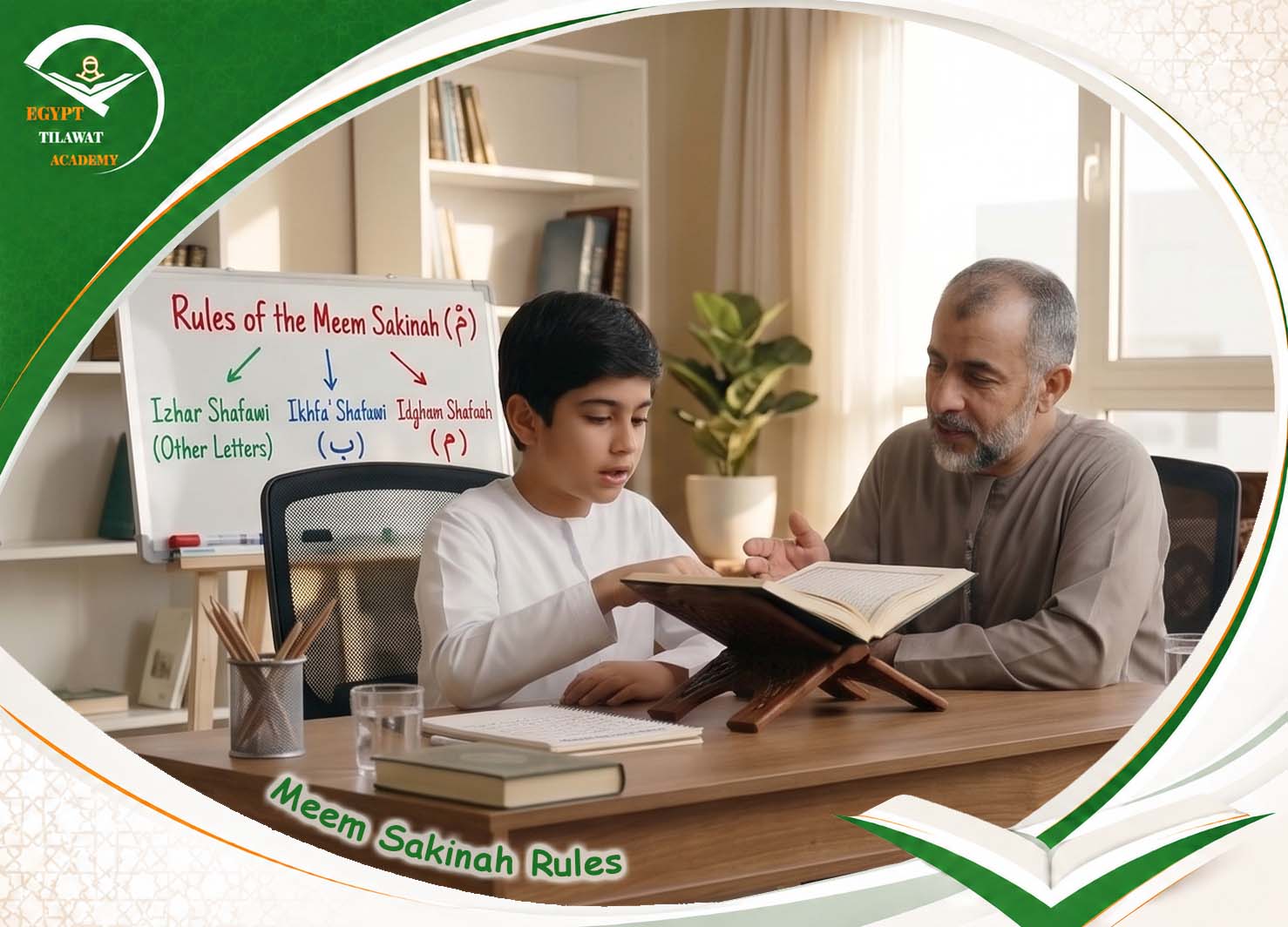
Meem Sakinah Rules: Ikhfa Shafawi and Idgham Shafawi
Meem sakinah (مْ) also carries ghunnah in two cases:
- Ikhfa shafawi
(labial hiding): meem sakinah followed by ba. Example: تَرْمِيهِم بِحِجَارَةٍ (tarmeehim-bihijaarah), Surah
Al-Feel 105:4. Keep the lips lightly together and add ghunnah.
- Idgham shafawi / idgham mithlayn (merging of identical letters): meem sakinah followed
by another meem. Example: لَهُم مَّا
(lahum-maa). The two meems merge into one with a clear ghunnah.
When meem sakinah is followed by any
other letter, it is pronounced clearly (idhar shafawi).
Where
Ghunnah Does NOT Apply Strongly
To avoid over-applying the rule,
remember these cases:
- Idhar (clear pronunciation): noon sakinah or tanween before the six throat letters
(ء ه ع ح غ خ) is pronounced
clearly, with no extended ghunnah.
- Idgham without ghunnah: noon sakinah or tanween before lam (ل) or ra (ر) merges
completely, with no nasal sound.
These are exactly the places where
students tend to add a nasal sound that should not be there.
Learning the full noon sakinah
system? See our guide to Noon Sakinah and Tanween Rules and Meem Sakinah Rules.
How
Long Should You Hold Ghunnah?
The standard length of ghunnah is two
counts (harakat).
A "count" is a unit of
time, roughly the time it takes to fold or open one finger at a natural, steady
pace, or the length of a normal short vowel stretched slightly. A simple method
for beginners:
- Say "inna" and hold the nasal sound while you
fold two fingers, one at a time.
- Release the sound as you finish the second finger.
- Repeat until the length feels natural.
Two counts are a guideline, not a
stopwatch measurement, and the exact feel comes from listening to a qualified
teacher. That is why live feedback matters: students often hold ghunnah too
briefly or too long without noticing.
Degrees
of Ghunnah in Tajweed: Strongest to Weakest
Scholars of tajweed describe ghunnah
as having ranks. Here is a quick-reference table:
|
Rank |
Case |
Example |
|
Strongest |
Noon or meem with shaddah |
إِنَّ،
ثُمَّ |
|
Strong |
Ikhfa, idgham with ghunnah, iqlab |
أَنتُمْ،
مَن يَعْمَلْ، مِن بَعْدِ |
|
Lighter |
Idhar |
مِنْ
آمَنَ |
|
Lightest |
Noon or meem with a vowel |
نَعَمْ،
مَا |
In practice, you give the full two
counts to the strong cases, and you keep the natural, light nasal quality in
the lighter ones without prolonging it. Your teacher will help you hear the
difference.
Common
Ghunnah in Tajweed Mistakes and How to Fix Them
- Holding it too long or too short. Aim for about two counts, and practice with a steady
rhythm.
- Producing it from the throat. The sound should resonate in the nose. Test by
pinching the nose gently: the sound should change.
- Dropping ghunnah in idgham or ikhfa. Remember that merging does not mean silencing: the
nasal sound stays.
- Over-applying ghunnah. Before lam, ra, and the throat letters, do not add a
nasal sound.
- Closing the lips in ikhfa. In ikhfa with noon, the lips stay open. Only iqlab and
ikhfa shafawi use lightly closed lips.
Most of these mistakes cannot be
heard by the student alone, which is why recording yourself and receiving
teacher feedback makes such a difference.
How
to Practice Ghunnah in Tajweed: A Simple 5-Step Routine
- Listen and imitate.
Play a slow recitation by a qualified reciter and repeat after them,
focusing only on the nasal sounds.
- Isolate the sound.
Practice "nnn" and "mmm" on their own, feeling the
resonance in your nose.
- Drill short examples.
Use the Quranic examples above, five repetitions each, at slow speed.
- Record and compare.
Record yourself, then listen to the reciter again and compare the length
and clarity.
- Get live feedback.
A teacher can correct what you cannot hear yourself and give you a
personalized plan.
Five to ten minutes a day is more
effective than one long weekly session. Tajweed is learned by listening, so
always pair written rules with audio.
Learn
Ghunnah and Tajweed with Egypt Tilawat Academy
Reading about ghunnah is a great
start, but nothing replaces hearing it and being corrected in real time. At Egypt
Tilawat Academy, you learn tajweed one-on-one with qualified Egyptian
teachers through live online Tajweed classes.
- Programs for every learner: adults, children, and new Muslims (reverts), starting
from the Arabic letters or from your current level.
- Flexible scheduling:
class times that suit the US, UK, Canada, and Australia.
- Personalized feedback: your teacher listens to your recitation, corrects your
ghunnah, and builds a plan around your needs.
- Free trial class:
meet a teacher and see how it feels before you commit.
Book your free trial class.
Explore our related courses: Tajweed Course, Noorani Qaida, Quran Memorization, and Arabic for Beginners.
Frequently
Asked Questions About Ghunnah
What
is ghunnah in simple words?
Ghunnah is the soft nasal sound you
make through your nose when pronouncing the letters noon (ن) and meem (م) in certain tajweed
situations. It sounds like a gentle hum. Reciters hold it for about two counts
to make the recitation smooth and accurate.
How
many counts is ghunnah?
Ghunnah is normally held for two
counts (harakat). A count is roughly the time it takes to move one finger at a
natural pace, so two counts are a short, steady hum. Your teacher will help you
get the exact length by ear.
Which
letters have ghunnah?
Ghunnah belongs to noon (ن) and meem (م).
It appears with a noon or meem carrying shaddah, with noon sakinah or tanween
in idgham with ghunnah, ikhfa, and iqlab, and with meem sakinah before ba or
another meem.
What
is the difference between ikhfa and idgham with ghunnah?
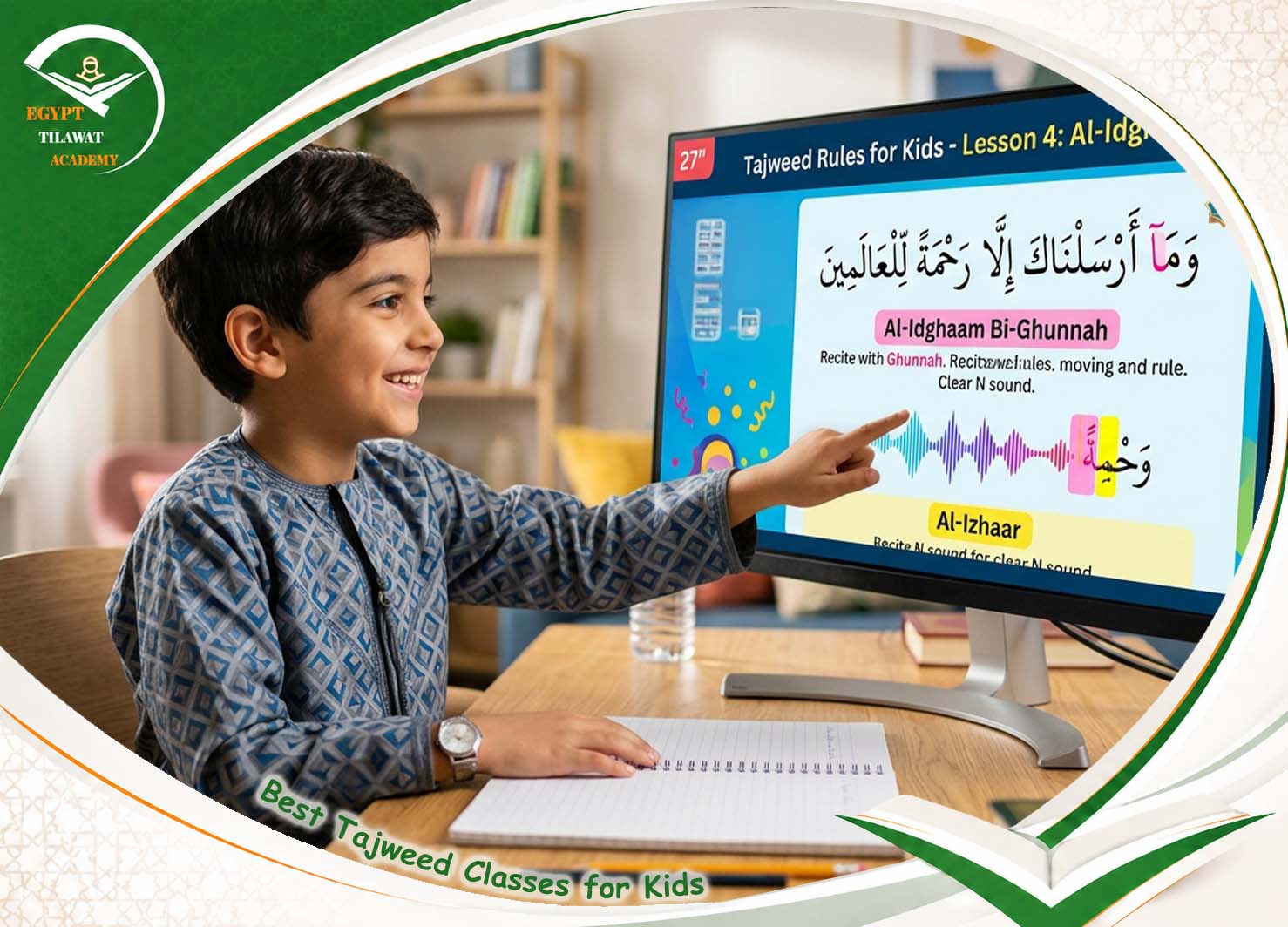
In idgham with ghunnah, the noon
merges into the next letter (ي ن م و)
and its own sound disappears, leaving only ghunnah. In ikhfa, the noon is
hidden but not fully merged, and the tongue prepares for the next letter among
15 letters. Both include ghunnah.
Is
ghunnah obligatory in tajweed?
Yes. Scholars of tajweed teach that
applying the rules of tajweed, including ghunnah, is required in recitation,
and neglecting it is considered a mistake in recitation. Beginners should learn
it gradually with a qualified teacher. If you have a specific question, ask
your teacher.
Can
beginners and reverts learn ghunnah online?
Absolutely.
Ghunnah in Tajweed is a small, repeated set of rules, and online one-on-one
classes let a teacher hear your recitation and correct it live.
Conclusion: Master Ghunnah in Tajweed to Improve Your Quran Recitation
Ghunnah in Tajweed may be a small sound, but it makes a big difference. Start with the strongest case, noon and meem with shaddah, then add idgham, ikhfa, and iqlab one at a time. Practice a little each day, listen closely to good reciters, and let a teacher guide you. May Allah make the Quran easy for you and beautify your recitation.
Ready to hear the difference? Book
your free trial class with Egypt Tilawat Academy today.